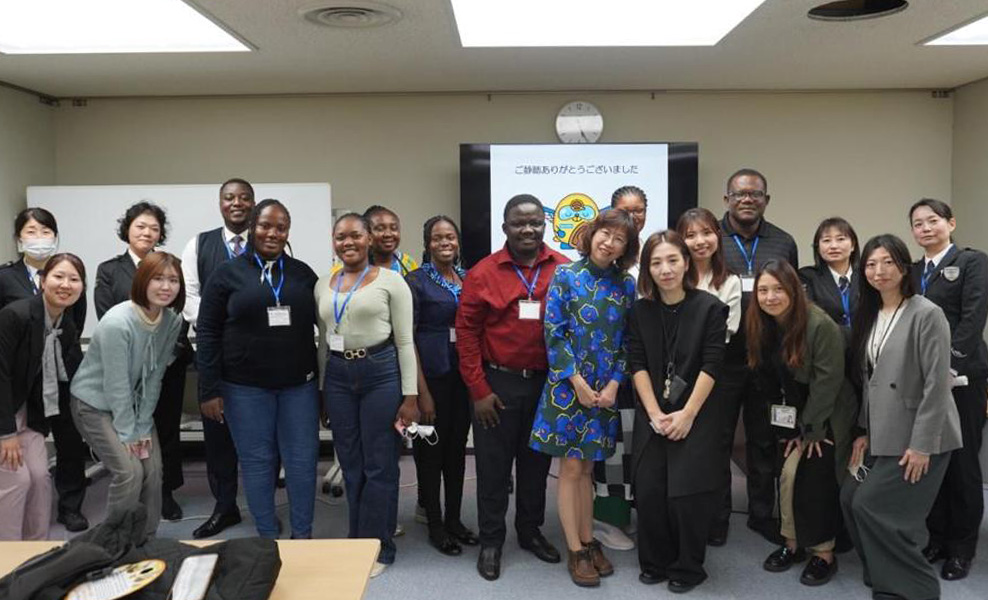
The School of Public has strengthened its international public health collaboration through participation in the Sakura Science Exchange Program in Japan, led by Prof. Yeetey Akpe Kwesi Enuameh, Vice Dean of the School of Public Health and a senior academic in the Department of Epidemiology and Biostatistics.
The exchange programme was hosted by the College of Nursing, School of Medicine and Health Sciences at the University of Tsukuba and focused on infectious disease control in the post-COVID-19 era, with emphasis on surveillance systems, immunisation strategies and emergency preparedness.
Prof. Enuameh led a multidisciplinary KNUST delegation comprising Miss Abena Kyerew Abebrese (PhD Nursing), Mr. Emmanuel Adusei-Poku (MPhil Nursing) and Miss Vida Annan (MPhil Nursing), all from the School of Nursing and Midwifery.
The programme opened with technical briefings on Japan’s public health and disease surveillance systems, led by Prof. Ryota Ochiai, Coordinator of the Sakura Science Exchange Program.

Participants engaged in structured sessions at the University of Tsukuba Hospital, where they examined infection prevention protocols, outbreak response procedures and the integration of digital technologies into routine public health surveillance.
As part of the academic exchange, the KNUST team presented Ghana’s experience in immunisation delivery and sexually transmitted infection (STI) prevention, facilitating comparative discussions on public health system performance in low- and middle-income and high-income settings.
The discussions highlighted shared challenges in maintaining vaccination coverage, managing antimicrobial resistance and strengthening data-driven decision-making.
The delegation also visited the National Institute of Infectious Diseases (NIID) and the National Center for Global Health and Medicine (NCGM) under the Japan Institute of Health Security.
Further academic sessions examined Japan’s national immunisation and STI prevention strategies, alongside a lecture by Prof. Nai-Yin Monica Ko of National Cheng Kung University, Taiwan, on the epidemiology and control of HIV, syphilis and hepatitis C. A technical visit to the Narita Quarantine Station highlighted border health surveillance systems used to prevent cross-border transmission of infectious diseases.
The programme concluded with joint Ghana–Japan group work addressing priority global public health threats, including HIV, tuberculosis and human papillomavirus (HPV). Group presentations focused on strengthening prevention, surveillance and response through evidence-based public health practice and international collaboration.